
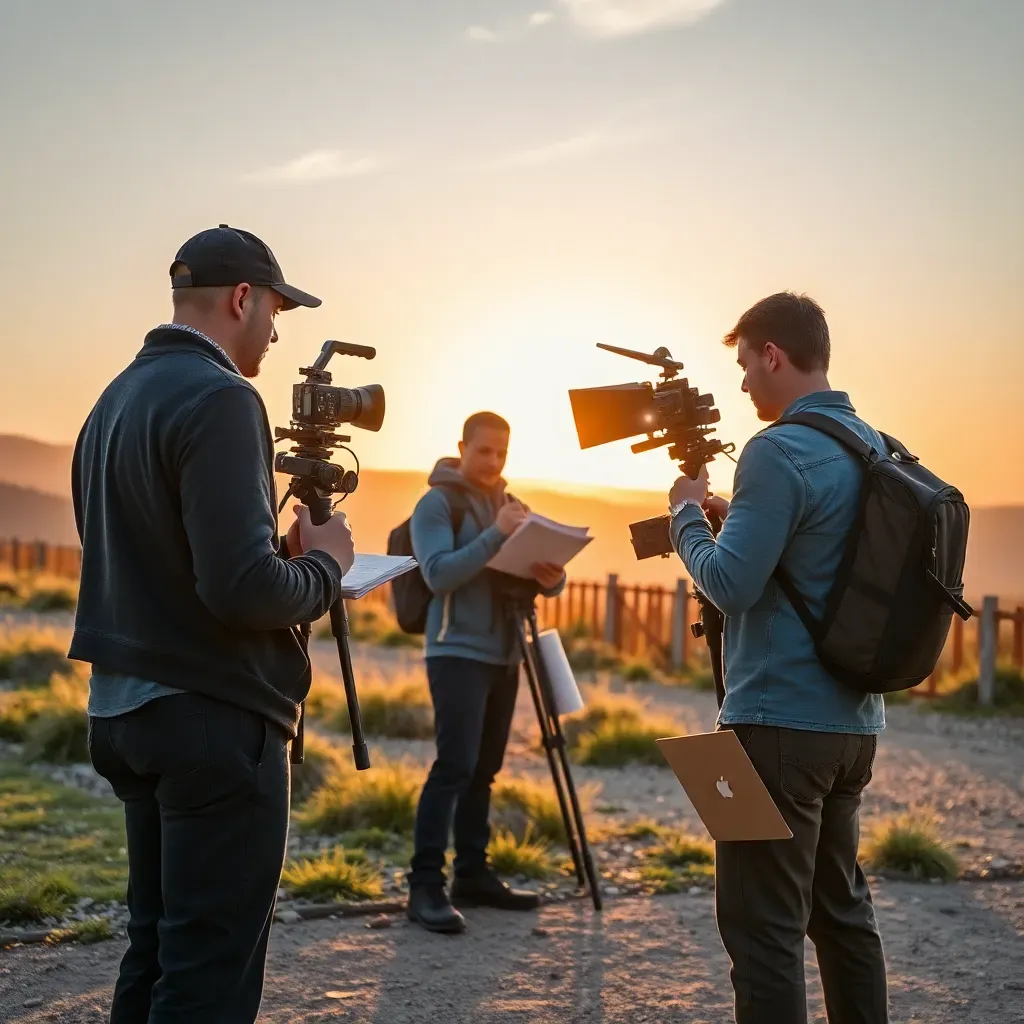
Filming in Berlin: Permits, Studios & Production Logistics
From Berlin Filmkommission permits and Studio Babelsberg stages to Mitte boulevards, Tempelhof airfield, and Medienboard funding — everything international productions need to plan a shoot in Berlin
Filming in Berlin — Dreharbeiten in Berlin — is one of the most flexible and most negotiable production operations in Europe. The city pairs the largest soundstage complex on the continent at Studio Babelsberg with a permit landscape set up by the Berlin Filmkommission, twelve Bezirk-level borough offices, and the Berlin police, plus visual signatures (Brandenburg Gate, Reichstag, Mitte's Karl-Marx-Allee, Kreuzberg's Görlitzer Park, the Tempelhof airfield) that producers chase from Los Angeles to Seoul. This guide walks through what global teams actually need to know to plan a production in Berlin: where to file permits. This stages match which formats, which neighborhoods deliver which looks, when to shoot, what the Medienboard 30% regional fund stacks with the federal DFFF, and how lead times shape your schedule. We work the Berlin film offices, Babelsberg stages, and crew rosters each week, so the focus here is operational, not editorial. Use it as a hub — each section links out to a deep-dive guide for the area you need to plan around.
As Fixers in Germany, we bring local expertise to international productions filming in Germany. Our team's deep knowledge of local regulations, crew networks, and production infrastructure ensures your project runs smoothly from pre-production through delivery.
ACT 01
Why Berlin for Production
Industry Depth, Infrastructure, and the Looks Producers Come For
Berlin is the operational center of German audiovisual production. The European base of choice for inbound features and series. The reasons global teams keep choosing it for film in Berlin go well beyond the postcards — it is one of the few European cities that combines a deep crew base, a stackable funding ecosystem, and a studio belt large enough to host Hollywood-scale shoots just outside the city limits.
- Germany produces 100+ feature films a year, with the majority crewed and funded out of Berlin and Potsdam
- DFFF, GMPF, and the Medienboard Berlin-Brandenburg 30% regional fund stack into a single application package
- Crew rosters cover German, English, Russian, Polish, Turkish, French, and increasingly Mandarin and Korean
- Brandenburg Gate, Reichstag, Mitte, Kreuzberg, Tempelhof, and the Babelsberg backlots all sit inside one shooting day
Industry Depth and the Berlin Production Ecosystem
Berlin film production runs on a tightly integrated ecosystem. The Berlin Filmkommission and Filmkommission Brandenburg set up locations, permits, and crew introductions across the dual-Land region. The Medienboard Berlin-Brandenburg administers the regional 30% production fund and works alongside the federal DFFF (Deutscher Filmförderfonds). The GMPF (German Motion Picture Fund) for global and high-volume shoots. Major TV networks (RBB, ZDF, ARD, RTL) and global streamers (Netflix, Disney+, Amazon, Apple, Sky) all have Berlin-based commissioning teams. That density means union talent, post houses, gear rental, insurance, customs brokers, and legal counsel for global shoots all sit within the same metro footprint. For inbound shoots, this translates to fewer hand-offs and shorter pre-production cycles than in any other German-speaking city.
Studio and Stage Infrastructure
The Greater Berlin studio belt is anchored by Studio Babelsberg in Potsdam. Europe's oldest large-scale film studio and the busiest single-site stage complex on the continent. Twenty-one soundstages, many backlots including the famous Berliner Strasse standing set, water tanks, and full virtual production infrastructure sit thirty minutes by S-Bahn from central Berlin. Inside the city, Studio Berlin Adlershof carries the broadcast and series workload, while smaller commercial and music-video stages cluster around Wedding, Lichtenberg, and Marzahn. That spread matters because global shoots can base talent and creative leads in central Berlin hotels and still keep production trucks and stage builds inside the standard travel-time radius.
Crew, Talent, and Language Coverage
Berlin crews are deep in each department. Cinematographers, gaffers, key grips, sound mixers, art directors, costume designers, hair and makeup, VFX supervisors, and stunt coordinators are ready at the union day rates published by the Bundesverband Schauspiel and the tech guilds. English fluency is standard at HOD level and increasingly common down to the assistant grades. Berlin is the most worldwide-staffed crew base in Germany. Talent agencies in Mitte, Charlottenburg, and Prenzlauer Berg represent the bulk of feature, series, and commercial talent, and casting directors here often handle global SAG and Equity-style negotiations on streaming-era shoots.
Signature Visual Looks
The visual reasons producers come to Berlin are well-known: Brandenburg Gate. The Reichstag for landmark and political beats, Mitte's Karl-Marx-Allee for Cold-War and brutalist registers, Kreuzberg's canal-side facades and street art for modern drama, Prenzlauer Berg's pre-war Altbau apartments for period and intimate work, the Tempelhof airfield for scale and aerial setpieces, and the Spree industrial corridor for hard-edged thriller and music video work. Babelsberg's standing sets. Berliner Strasse, Metropolitan Backlot, the New York street — extend the look library to anything from 1920s Babylon Berlin to modern Manhattan. Each of these is briefed in detail below, with guidance on how shoot in Berlin workflows actually clear them.
ACT 02
Filming Permits in Berlin
Berlin Filmkommission, the Bezirke, and the Permit Landscape
Berlin filming permits are set up by the Berlin Filmkommission as a first point of contact, with operational authority distributed across the twelve Bezirke (boroughs), the Berlin police (Polizei Berlin), and federal authorities for landmark sites. This section gives you the operational summary — for the full step-by-step on records, fees, and edge cases, see our deep-dive guide.
- The Berlin Filmkommission sets up introductions and routes requests to the right Bezirk office
- Each of Berlin's twelve Bezirke (Mitte, Friedrichshain-Kreuzberg, Pankow, etc.) issues its own street and public-domain permits
- Polizei Berlin handles traffic stops, road closures, perimeters, stunts, weapons, and pyrotechnics
- BVG (U-Bahn, tram, bus) and S-Bahn Berlin need their own permits with separate lead times
- Heritage and federal sites — Reichstag, Brandenburg Gate plaza, Bundestag perimeter — are ruled by their own authorities
Berlin Filmkommission and the Bezirk-Level Permit System
The Berlin Filmkommission is the single starting point for most public-domain filming in Berlin. But it is a planning office, not a permit-issuing authority. The actual permits are issued by the Bezirksamt (borough office) of whichever Bezirk hosts your location. Mitte, Friedrichshain-Kreuzberg, Pankow, Charlottenburg-Wilmersdorf, Spandau, Steglitz-Zehlendorf, Tempelhof-Schöneberg, Neukölln, Treptow-Köpenick, Marzahn-Hellersdorf, Lichtenberg, or Reinickendorf. Each Bezirk has its own Sondernutzung (special use) office, its own fee schedule, and its own processing rhythm. Standard street shoots with a small footprint are mostly clearable in two to three weeks. Larger setups — full lighting packages, power packs, picture cars, base camp — extend the lead time to four to six weeks and trigger Polizei Berlin planning. The Filmkommission's role is to broker introductions, advise on which Bezirk is most receptive to a given concept, and surface scheduling conflicts between competing shoots.
Polizei Berlin and Traffic Coordination
Anything that affects road traffic, needs a security perimeter, or involves stunts, weapons, pyrotechnics, drones, or large crowd scenes routes through Polizei Berlin. Boulevard closures along Unter den Linden, the Straße des 17. Juni, or the Ku'damm are in tech possible but need the longest lead times in the city — eight to twelve weeks is realistic. BVG cooperation on tram and bus diversions adds two to four weeks on top of that. Drone operations need a Luftfahrt-Bundesamt (LBA) clearance and specific pilot certification, with no-fly zones over the government district, both Berlin airports, and parts of the Tiergarten that no permit can override.
BVG, S-Bahn, and Heritage Sites
Filming inside or adjacent to the BVG network — U-Bahn stations, trams, buses — runs through BVG's dedicated film office, not the Bezirk. The same applies to S-Bahn Berlin for the elevated rail network, including platforms at Hackescher Markt, Friedrichstraße, and Alexanderplatz. Lead times here run four to eight weeks, fees are tiered by station footfall and shoot length, and many shoots are off-limits to off-peak windows or non-revenue all-night blocks. Federal landmarks — the Reichstag building, Brandenburg Gate plaza, the Bundeskanzleramt perimeter, Holocaust Memorial — are ruled by federal authorities (Bundestag, BImA, foundation administrations) rather than Berlin city offices, with lead times of six to twelve weeks. For a complete walkthrough of permit types, fees, records, and rejection-recovery tactics, see our Berlin permit deep-dive at /blog/film-permits-guide/.
ACT 03
Studios in Berlin
Studio Babelsberg, Studio Berlin Adlershof, and the City Stages
Berlin's studio infrastructure is anchored by Studio Babelsberg in Potsdam — thirty minutes from Mitte by S-Bahn — and complemented by city-side stages and a dense post-prod cluster. The lineup below is a working summary. The full sourcing guide with stage dimensions, ceiling heights, water tank specs, and virtual production volumes lives in our dedicated studios article.
- Studio Babelsberg (Potsdam) — Europe's oldest and largest single-site film studio, 21 soundstages and many backlots
- Studio Berlin Adlershof — broadcast and series workhorse with seven soundstages in southeast Berlin
- Atelier Pankow, Stage Studios, and the Wedding/Lichtenberg commercial belt — flexible mid-size stages
- Full virtual production volumes ready at Babelsberg Volume and at independent LED stages in Berlin
Studio Babelsberg — Potsdam
Studio Babelsberg in Potsdam is the largest and longest-operating film studio in Europe, founded in 1912 and all the time active through the silent era, UFA, DEFA, and the modern global era. Twenty-one soundstages totaling more than 25,000 m² of stage space sit on the campus, alongside the Berliner Strasse standing set (used for The Pianist, Inglourious Basterds, Babylon Berlin), the Metropolitan Backlot, a New York street set, water tanks, and the Babelsberg Volume LED virtual production stage. It has hosted shoots from The Bourne Ultimatum and Bridge of Spies to Inglourious Basterds, V for Vendetta, The Hunger Games: Mockingjay, and the long-running Babylon Berlin and Dark series. For inbound shoots running long-form drama or large-format features, Babelsberg is the default first call when central Berlin hotel bases are needed and stage-to-location turnarounds need to stay under an hour.
Studio Berlin Adlershof — Southeast Berlin
Studio Berlin Adlershof, in the historic UFA broadcast quarter southeast of the city, is the workhorse for German television drama and the main alternative to Babelsberg for shoots that need to stay inside the city limits. Seven soundstages, full broadcast galleries, scenic shops, and dressing facilities sit on a single site with on-campus parking — useful when production trucks would otherwise struggle with central Berlin loading restrictions. Adlershof is the regular home of major German prime-time drama and entertainment formats. This means crew rosters in the southeast are exceptionally deep and short-term stage availability is more flexible than at Babelsberg.
City-Side Stages and the Commercial Belt
Inside the S-Bahn ring, a constellation of mid-size stages serves the commercial, music video, fashion, and editorial workload. Atelier Pankow, the Wedding stage cluster, Lichtenberg's converted industrial buildings, and Marzahn's larger sound stages cover most of the bread-and-butter commercial work that does not need a Babelsberg footprint. Build-day logistics across this belt are tight: art-department workshops, prop houses, and gear rental are concentrated in Wedding, Lichtenberg, and around the Ostkreuz hub. This keeps prep cycles inside one geography.
Virtual Production and the Equipment Side
Berlin and Babelsberg together host one of Europe's deepest virtual production sizes. The Babelsberg Volume gives a full LED wall stage with Unreal Engine integration. Independent operators in the city run smaller LED volumes for episodic and commercial work. Gear rental from ARRI Rental Berlin, Cinegate, Maier Bros, and the major lighting and grip houses sits within the city, bridging the gap between stage rental and the gear side. For shoots building bespoke stages or running blue/green-screen work without committing to a full Babelsberg footprint, the city-side rental network is often the most flexible partner. For full stage matrices, daily rates, and the stages best suited to virtual production and LED-volume work, see our Berlin studios sourcing deep-dive at /blog/studio-soundstage-options/.
ACT 04
Locations in Berlin
The Visual Categories That Bring Producers to the City
Berlin's strength as a location city is the breadth of distinct visual registers within a small radius — from imperial Wilhelmine grandeur to Cold-War concrete to modern techno-industrial. The types below cover most of what global shoots request — for the operational scout files (best times of day, light, foot traffic, permit difficulty), see our Berlin location scouting guide.
- Brandenburg Gate, Reichstag, and the government quarter for landmark and political beats
- Mitte's Karl-Marx-Allee, Alexanderplatz, and Fernsehturm for Cold-War and brutalist registers
- Kreuzberg canals, Görlitzer Park, and street-art corridors for modern drama
- Prenzlauer Berg Altbau apartments, Mauerpark, and Kollwitzplatz for period and intimate work
- Tempelhof airfield — the largest urban open space in Europe, ideal for scale and aerial sequences
- Spree industrial corridor — Friedrichshain warehouses, Holzmarkt, and the East Side Gallery
- Charlottenburg's Schloss, Ku'damm boulevards, and bourgeois interiors for period luxury
- Tiergarten and the embassy quarter for green-canopy and diplomatic-register work
Brandenburg Gate, Reichstag, and the Government Quarter
The Brandenburg Gate, Reichstag, and the government quarter (Regierungsviertel) form the most-photographed cluster in Berlin and the single most-requested setting up geography for inbound shoots. The plaza in front of the Brandenburg Gate is a federal-managed space — permits route through BImA. The Bundestag admin, with strict gear-footprint limits and crowd-control conditions. The Reichstag exterior is shootable from designated angles. Interior access needs a separate Bundestag application with six-to-twelve-week lead times. The wider government quarter. Bundeskanzleramt, Paul-Löbe-Haus, Marie-Elisabeth-Lüders-Haus along the Spree bend — gives some of the city's most cinematic modern build style, with shoot windows that work cleanly outside Bundestag sitting weeks.
Mitte, Karl-Marx-Allee, and the Cold-War Register
Mitte beyond the tourist core delivers the Cold-War and brutalist registers that global shoots cannot find anywhere else at this scale. Karl-Marx-Allee — the monumental Stalinist boulevard that runs from Alexanderplatz to Frankfurter Tor — is one of Europe's most distinctive shooting axes, with vast pavements that absorb full lighting packages and traffic patterns that allow rolling closures rather than full shutdowns. Alexanderplatz, the Fernsehturm, the Karl-Liebknecht-Strasse, and the rebuilt Berliner Schloss complete the picture. The Friedrichshain side is tourist-light outside summer weekends. This means the in practice cleanest shoot windows are weekday mornings from \1 and 9 AM.
Kreuzberg, Prenzlauer Berg, and Atmospheric Quartiers
Kreuzberg's canal-side facades along the Landwehrkanal, the Görlitzer Park edges, the SO36 corridor, and the street-art geography around Skalitzer Strasse deliver the modern register that defines a large share of inbound music video and short-form drama work. Prenzlauer Berg gives pre-war Altbau apartment blocks, leafy squares (Kollwitzplatz, Helmholtzplatz), the Mauerpark Sunday market geography, and the Kulturbrauerei industrial campus — a complete kit for period, intimate, and lifestyle work. Both quartiers are residential, so lead times skew longer for full-gear shoots and early-morning windows (5–9 AM) are mostly the operational answer for street-level work.
Tempelhof, the Spree Industrial Corridor, and the Modern Skyline
Tempelhofer Feld — the decommissioned airfield turned 300-hectare urban park — is one of the most distinctive shooting environments in any European capital. The runways, hangars, terminal building, and the surrounding flat horizon support scale, aerial, and stunt work that would be impossible inside the city anywhere else. Permits route through Tempelhof Projekt GmbH. The Tempelhof-Schöneberg Bezirk, with lead times of four to eight weeks and dedicated film-friendly access points. The Spree industrial corridor between Friedrichshain and Treptow. Holzmarkt, the YAAM beach, Osthafen, the East Side Gallery, the RAW-Gelände — gives the hard-edged modern and warehouse-thriller register. Charlottenburg's Schloss, the Ku'damm, and the Tiergarten embassy quarter complete the visual library at the bourgeois and diplomatic end. For the full taxonomy with permit difficulty ratings and shoot-window guidance, see /blog/location-scouting-tips/ and our /services/pre-production/location-scouting-services/ page.
ACT 05
Seasonal Considerations for Filming in Berlin
Best Months, Weather Risks, and Berlinale Blackout
When you shoot in Berlin matters almost as much as where. The city has a clear summer-favored shoot envelope, predictable weather risks, and one major festival that compresses availability. Plan against this calendar from the first scout.
- Best operational months: May through September, with June and July offering the longest daylight in Europe
- Summer (Jun–Aug) brings up to 17 hours of usable daylight but also tourist density and afternoon thunderstorm risk
- Winter (Dec–Feb) is cold and overcast but gives fast permits, distinctive aesthetic, and zero tourist competition
- Berlinale (early-to-mid February) effectively removes the city from the production pipeline for two weeks
Weather, Light, and the Production Calendar
Berlin sits at 52.5° north — further north than Vancouver — which gives it the longest summer days and the shortest winter days of any major European production hub. May through early September gives 14 to 17 hours of usable daylight, with June delivering twilight that runs almost to 11 PM. Summer weather is mostly cooperative but afternoon thunderstorms become a real risk from mid-June through August. August itself has the city's heaviest tourist density. September is the most reliable month of the year — stable weather, clean light, and crew availability that recovers from the August holiday slowdown. Mid-November through February compresses shoot days to 7 to 8 hours of usable light and brings the persistent overcast and cold (often -5° to -10°C in January) that suits some looks (Cold-War drama, gritty thriller, Christmas specials) and frustrates others (high-key fashion, anything with sun-flare).
The Berlinale Blackout and Festival Calendar
The Berlin International Film Festival — the Berlinale — runs for ten days in early-to-mid February and is the single biggest fixed point on the Berlin production calendar. It drains key crew across town for festival duties, saturates hotel inventory in Mitte and Potsdamer Platz, locks down major portions of the area around the Berlinale Palast and the Sony Center, and triggers higher rates on left crew and gear. Plan around it from the first scout — shoots that try to shoot through Berlinale week always lose money. Other windows worth noting: the Karneval der Kulturen (Pentecost weekend in Kreuzberg), Pride/CSD (late July, central districts), the Festival of Lights (October, landmark sites), and the Christmas market weeks (mid-November to late December) which lock down major portions of Mitte, Charlottenburg, and Schöneberg.
Winter Aesthetic and the Year-Round Calendar
Berlin's winter is genuinely cold — often below freezing for weeks — but the aesthetic it delivers is unique in European production: bare linden trees on Unter den Linden, snow on the Karl-Marx-Allee, fog over the Spree, and the low-angle northern light that defines the look of Babylon Berlin and a generation of German cinema. Permits move faster in winter (Bezirk offices have lighter caseloads), tourist competition is non-existent outside Christmas markets, and crew availability is at its most flexible. Productions willing to handle cold-weather logistics — heated tents, battery management, extended make-up time — find Berlin's winter the most negotiable production environment in the city's calendar. See our /locations/berlin/ landing page for an overview of how we structure scouting around these constraints.
ACT 06
Crew Availability and Costs in Berlin
Lead Times, Day Rates, and the Medienboard + DFFF Stack
Berlin gives Germany's deepest crew availability and one of Europe's most generous incentive stacks — the Medienboard Berlin-Brandenburg 30% regional fund layers cleanly with the federal DFFF and the GMPF. Plan crew bookings against the city's calendar and price the incentive stack into the budget from day one.
- DOPs, key grips, gaffers, and sound mixers: 4–8 weeks lead time for top tier, 2–3 weeks for mid-tier
- Production designers and costume designers: 6–10 weeks for prep-heavy shoots
- Stunt coordinators, SFX supervisors, and underwater units: 6–12 weeks for full-scale work
- Medienboard Berlin-Brandenburg returns up to 30% of qualifying regional spend, stackable with DFFF (20–25%) and GMPF (25%)
Lead Times for Booking Key Roles
For a typical inbound feature or six-episode series shooting in Berlin, plan eight weeks minimum from script lock to first day of principal photography just for crew booking. Director of photography, production designer, and 1st AD are mostly the binding constraints — top-tier Berlin talent is booked across many competing shoots year-round, and the same crew pool serves Babelsberg's heavy global workload. Mid-tier department heads and the bulk of crew (camera assistants, electricians, grips, sound utilities, costume team, hair and makeup) are mostly ready with two to three weeks notice outside the Berlinale window. Commercials run on tighter schedules — typical lead time for a five-day Berlin commercial is two to three weeks for crew, one week if the agency has standing relationships in Mitte and Kreuzberg.
Day Rates and Budget Anchors
Berlin crew day rates follow the Tarifvertrag für Film- und Fernsehschaffende collective agreement. This sets minima by department and seniority. In practice, expect roughly €550–850/day for camera assistants, €850–1,300/day for gaffers and key grips, €1,300–2,100/day for DOPs, €1,900–3,300/day for production designers, and significantly higher for global name talent on negotiated contracts. Add roughly 20–22% for social charges (Sozialabgaben) on German payroll plus the producer's share of pension and health inputs — meaningfully lower than France's 50–55% load. Gear rental, location fees, and base-camp logistics are broadly competitive with London and meaningfully cheaper than New York or Los Angeles for equivalent specs. This is one of the structural reasons Berlin and Babelsberg have absorbed so much streaming-era inbound work.
Medienboard, DFFF, GMPF, and the Incentive Stack
The Berlin incentive stack is one of Europe's most attractive for global shoots. The Medienboard Berlin-Brandenburg administers a regional production fund that returns up to 30% of qualifying spend in the Berlin-Brandenburg region (subject to selective approval and a regional spend test). On top of that, the federal DFFF (Deutscher Filmförderfonds) returns 20% of qualifying German spend (25% with German distribution attached), and the GMPF (German Motion Picture Fund) — designed for global high-volume shoots and series — returns up to 25% of qualifying German spend with a higher per-project ceiling. These instruments stack: a production with a €5 million Berlin shoot can realistically combine Medienboard regional support, DFFF, and GMPF into a blended return well above 40% of qualifying German spend, subject to caps and the cultural test. The full mechanics, application timeline, and records needs are covered in our /blog/film-tax-incentives-guide/ — and our team can walk you through which combination of instruments fits your project before you commit to a Berlin production base. To start a Berlin production conversation, contact us at /contact/ with your script status, shoot window, and budget envelope.
ACT 07
Common Questions
How long do filming permits take in Berlin?
Standard street filming permits issued by the relevant Bezirksamt typically take two to three weeks once paperwork is complete. Larger setups with lighting, generators, picture vehicles, or base camp extend to four to six weeks because they require Polizei Berlin coordination. Major road closures (Unter den Linden, Straße des 17. Juni, Ku'damm) take eight to twelve weeks, and BVG cooperation adds two to four weeks on top. Federal landmarks — Reichstag, Brandenburg Gate plaza, Holocaust Memorial — run six to twelve weeks under their own administrations. Always build buffer for the Berlinale week in February, when nothing moves quickly.
Can I shoot in public spaces in Berlin?
Yes, with a Drehgenehmigung from the relevant Bezirksamt — Berlin's twelve boroughs each run their own permit office, coordinated through the Berlin Filmkommission. Streets, squares, parks, canals, and most public space are accessible to filming with the right permit, insurance certificate (typically €1.5–3 million public liability), and a local production representative. Anything affecting road traffic, requiring crowd control, or involving stunts and pyrotechnics also needs Polizei Berlin clearance. Federal landmarks and BVG/S-Bahn infrastructure go through their own offices. Handheld shoots with a small crew and no equipment footprint can sometimes proceed under simplified declarations — confirm with your fixer before relying on that route.
What is the best season to shoot in Berlin?
May through September is the reliable shoot envelope, with June and July delivering up to 17 hours of usable daylight — the longest in any major European production city. September is the single most stable month: warm enough for exteriors, dry enough to plan against, and clear of the August holiday slowdown. Avoid the Berlinale blackout (early-to-mid February), Pride/CSD weekend (late July, central districts), and the Christmas market weeks (mid-November to late December) which lock down Mitte, Charlottenburg, and Schöneberg. Winter is cold and short on daylight (7–8 usable hours in December and January) but offers fast permit access and a distinctive Cold-War aesthetic.
Do I need a fixer to shoot in Berlin?
For practical purposes, yes. The Bezirk-level permit system, BVG coordination, and most landmark authorities require a local production representative who can respond to on-set issues, file German-language paperwork, and act as the named contact on the Drehgenehmigung. International productions also need German payroll for any local crew (Sozialabgaben and the producer's share of social contributions), German insurance recognised by the permit office, and customs handling for equipment imports. A Berlin fixer or local production service company holds these relationships across the twelve Bezirke, the Filmkommission, the Medienboard, and the federal funding offices, and is generally faster, cheaper, and lower-risk than building those relationships from scratch for a single production.
What are typical day rates for Berlin crew?
Berlin crew day rates run roughly €550–850 for camera assistants and electricians, €850–1,300 for gaffers and key grips, €1,300–2,100 for directors of photography, and €1,900–3,300 for production designers — all per the Tarifvertrag für Film- und Fernsehschaffende. Add roughly 20–22% for social charges on top of every German payroll line, plus the producer's pension and health contribution share. Equipment rental, location fees, and base-camp logistics are competitive with London and meaningfully cheaper than New York or Los Angeles. The Medienboard 30%, DFFF 20–25%, and GMPF 25% incentive stack offsets a substantial share of total Berlin spend for qualifying international productions.
Ready to Roll
Planning a Production in Berlin?
Whether you are scouting Karl-Marx-Allee for a Cold-War feature, locking a Babelsberg stage for a streaming series, or scheduling a five-day commercial around the Berlinale and the Christmas markets, our Berlin team has the permits, crews, and studio relationships ready to go. Dreharbeiten in Berlin is what we do every week — and we run the operational side so directors and producers can focus on the work. Contact Fixers in Germany to discuss your next project.